
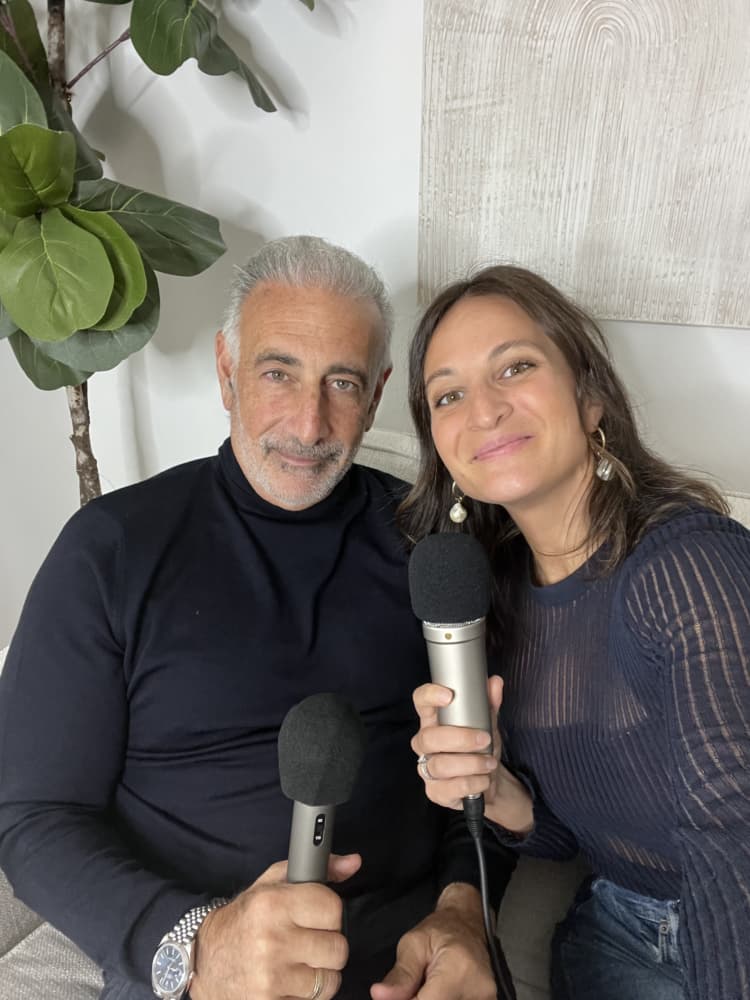


This post was written by Risely Health founder Lauren Bongiorno.
For nearly a decade, my dad would casually mention that his A1C was creeping up.
Not in a dramatic way. Almost in passing. He’d say something like, “Yeah, so weird my A1C went up a little again,” and then move on to something else.
A few years earlier, my dad had found out he had a cardiac aortic aneurysm. It was terrifying, and I even had a few panic attacks thinking about losing him because of it. He knew how deeply that experience had shaken me, and I think, on some level, he didn’t want to alarm me again. So he kept his blood sugar updates light and said it was pre diabetes that he was going to take care of.
And honestly, hearing that explanation didn’t raise any red flags for me.
I know that roughly half of adults in the U.S. are either prediabetic or have type 2 diabetes. I also know that as we get older, insulin resistance naturally increases. So when my dad’s A1C was increasing, I didn’t question it. It fit the statistics. It fit the narrative we’re used to hearing.
My dad is also one of the most health-conscious people I know. He exercises consistently. He pays attention to what he eats. But still, over the years, the numbers kept moving in the wrong direction.
By 2017, his A1C was a 5.7.
In 2019, it reached 6.0.
By 2020, it was 6.3.
And in 2022, it hit 7.1.
He was doing everything right, yet the data told a different story.
When doing “everything right” still isn’t enough
One thing to know about my dad is that he goes 100% into anything he’s focused on. So his rising A1C was especially driving him crazy because he got to the point of, “what else can I even be doing?” He was working out 2x a day. He shifted his diet multiple times, moving from vegetarian to vegan, reducing carbohydrates, and even following a very low-fat plant-based approach for months at a time.
But ultimately when his A1C reached 7.1, his doctor prescribed metformin and at that point, my dad “loosely” accepted it was type 2 diabetes. And in many ways, the medication seemed to confirm it.
Because metformin worked.
His A1C dropped back into the low 6s.For a while, that felt reassuring. It looked like proof that the diagnosis was correct. That this really was type 2 diabetes and that medication, combined with lifestyle changes, was doing what it was supposed to do
And because there was some improvement, no one felt the urgency or need to look deeper.
The moment everything clicked
The turning point didn’t happen in a doctor’s office. It happened at my parents’ dinner table.
I was visiting them in Florida for a week and one night we were eating dinner together, talking about work. Specifically, I was sharing that we’d had a wave of people come through Risely who had spent years being treated for type 2 diabetes, only to eventually learn they actually had LADA, adult-onset type 1 diabetes.
I wasn’t telling the story about my dad. I was just talking.
“It’s not a quick diagnosis like when you’re diagnosed as a child. It’s slow and can happen over many years….”
As I said it outloud, it was like another voice was in my head saying “hello, you’re literally describing your dad.”
My mom and I looked at each other at the exact same time.That quiet, instant “oh my god” moment. The kind where you don’t even have to say it out loud.
It was the same story.
I looked at my dad and said, “I think you might be Type 1…”
He definitely was as shocked to hear it as I was to say it, but he asked,“Okay how do we find out for certain”
It wasn’t fear. It was a curiosity. And relief.
For the first time, there was a way to explain what hadn’t made sense for years.
What the tests revealed
Once the possibility of adult-onset type 1 was on the table, the next question was obvious.
How do you actually know?
My dad wanted clarity, not guesses. So his doctor ordered tests designed to look beneath the surface, beyond A1C and fasting glucose.
Here’s what they looked at:
- C-peptide
This shows how much insulin the pancreas is still producing. In slow-progressing autoimmune diabetes, insulin production doesn’t disappear all at once. It can decline gradually, which helps explain why blood sugars may respond somewhat to lifestyle changes or medications early on. - Glutamic acid decarboxylase (GAD) antibodies
This test looks for autoantibodies that signal the immune system is attacking insulin-producing cells. GAD antibodies are one of the most common markers seen in adult-onset type 1 diabetes. - Islet cell antibodies (ICAs)
This test also looks for autoantibodies targeting the insulin-producing cells in the pancreas, pointing to an autoimmune process rather than insulin resistance alone.
When those results came back, everything finally clicked.
His C-peptide levels showed he was still producing insulin but his autoantibody levels were extremely high. My dad tested positive for type 1 diabetes autoantibodies, consistent with tracking towards having adult-onset autoimmune diabetes, often referred to as LADA.
For him, the diagnosis wasn’t devastating. It was relief.
Because it finally explained why effort had never fully matched outcomes.
The part I missed too
I’ve thought a lot about how I didn’t see this sooner.
I’ve lived with type 1 diabetes for more than 20 years. We coach hundreds of people every year with all different diagnosis stories. And somewhere along the way, I internalized the idea that if anyone else in my family were to develop type 1, it would happen earlier. Or it would happen to my sister. Not my dad. Not in his 60s.
I also carried this identity of being “the only type 1 diabetic” in my family, since 90% of people who have T1D don’t have any family history of the disease.
And because my dad’s blood sugars did respond somewhat to lifestyle changes and metformin, the idea of it being T1D felt less obvious.
This is exactly how LADA ( latent autoimmune diabetes in adults) hits many people. Because insulin production declines gradually, blood sugars often respond to lifestyle changes or medications early on. That partial response is one of the main reasons it’s so frequently misdiagnosed as prediabetes or type 2 diabetes.
But still, my frustration was that my dad’s doctor knew that I had Type 1, and still, that possibility never was mentioned.
Where things stand now after finding out he had T1D autoantibodies
More than two years after testing positive for type 1 diabetes autoantibodies, my dad is still not taking insulin. Clinically, he hasn’t reached what’s considered stage 3 type 1 diabetes. He’s still producing enough insulin to function, which puts him in a gray area that isn’t talked about nearly enough.
Today, his A1C remains in the low 6s with a combination of metformin, daily workouts that include both cardio and strength training, and being really intentional with his nutrition.
He wears a continuous glucose monitor, which helps him see how different foods and activities affect his blood sugar in real time. Some higher-carb meals will still spike him into the 250s, but interestingly, the biggest contributor to elevated numbers tends to be overnight, likely driven by growth hormone release and delayed fat digestion.
When I shared my dad’s story publicly, we didn’t know how long it would be before his C-peptide levels dropped completely. I honestly feared the worst. Given that his A1C had been climbing steadily for nearly a decade, I assumed things would progress quickly. I thought the next update I’d be sharing would be that he had started insulin.
That hasn’t been the case.
I know a lot of people have been curious about what his journey has looked like since that initial diagnosis, so I wanted to share this update, not because it’s a neat or linear story, but because it reflects the reality many adults with autoimmune diabetes live in. This in-between stage. The waiting. The uncertainty.
My dad’s story isn’t rare. It’s under-recognized.
And I truly believe that better education around type 1 diabetes screening, especially in primary care, could spare so many people years of confusion and self-blame. It certainly did for my dad.